Top story of the week: Geopolitics dominates Davos as climate and energy transition fade from view
Share this page
by Rosita Zilli, Policy Director, and Marianne Lazarovici, Policy Officer
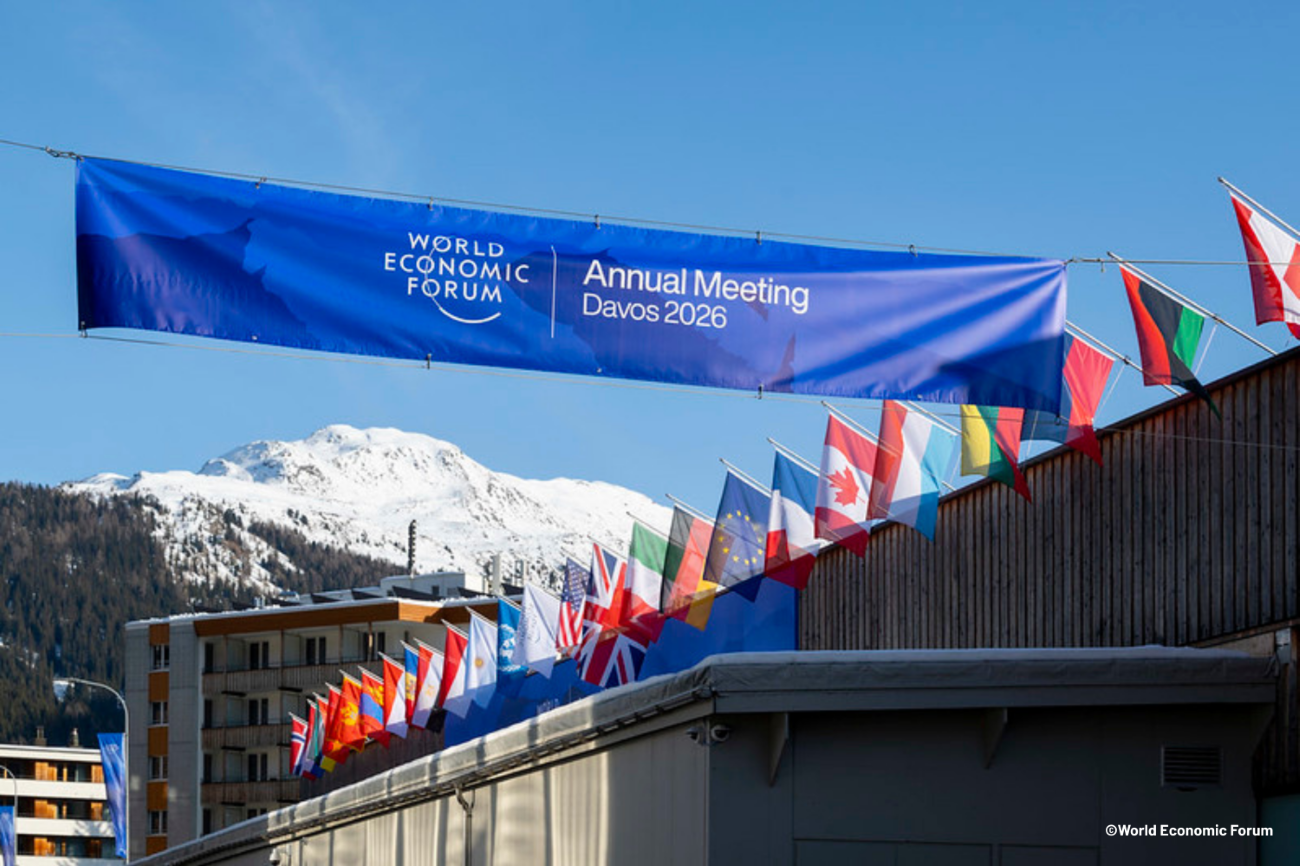
All eyes turned to Davos, Switzerland, last week, where the World Economic Forum (WEF) took place from 19 to 23 January. This year’s gathering of heads of state and government, ministers, industry leaders and civil society representatives was strongly geopolitical, with security concerns and economic rivalry dominating discussions, while climate and energy transition issues received comparatively less attention.
For the European Union, tensions with the United States were among the summit’s central points. In the run-up to Davos, US President Donald Trump reiterated threats of new tariffs on EU products and made provocative statements regarding the strategic importance of Greenland, a Danish autonomous territory. Framed around security and access to raw materials, these remarks drew significant political and media attention and raised concerns about a potential escalation in transatlantic tensions. Despite this heightened focus, no concrete agreements or de-escalation measures emerged, leaving uncertainty over the implications for EU–US relations.
Against this backdrop, climate action and the energy transition took a comparatively lower profile. While previous editions of the WEF have provided platforms for high-profile climate initiatives — including the launch of the Global Energy Transition Forum by European Commission President Ursula von der Leyen — discussions on decarbonisation were less visible this year, amid a context in which several US political figures openly criticised renewable energy, promoted fossil fuels and questioned the urgency of climate-related risks.
Nevertheless, prominent figures such as former US Vice-President Al Gore, International Energy Agency Executive Director Fatih Birol and EU Climate Commissioner Wopke Hoekstra addressed decarbonisation in speeches and panel discussions, often framing it through the lens of competitiveness and security.Energy security emerged as a recurring theme, alongside electric mobility, critical raw materials, supply chains and the potential role of nuclear power in meeting rising electricity demand, including that linked to artificial intelligence.
China also sought to highlight its commitment to the green transition. Vice-Premier He Lifeng called on participants to “embrace the opportunities of the green and low-carbon transition” and reaffirmed China’s pledge to peak carbon emissions before the end of the decade.
Research and innovation featured in a dedicated series of discussions at the WEF’s Science House. Contributions from leading figures in European research policy, including European Research Council President Maria Leptin, emphasised the strategic importance of science and innovation. Economist Philippe Aghion, winner of the 2025 Nobel Prize in Economics, urged the EU to strengthen its research and innovation ecosystem and competition policy to better support breakthrough innovation and the commercialisation of European research, reiterating the need for European equivalents of the US Defense Advanced Research Projects Agency (DARPA). In this context, André Loesekrug-Pietri, Chairman and Scientific Director of the Joint European Disruptive Initiative (JEDI), announced the launch of the JEDI Draghi Tracker, a quarterly assessment of progress in implementing the Draghi report on European competitiveness.
Overall, the summit highlighted the ongoing challenge of maintaining sustained political attention for the energy transition and research and innovation in an increasingly fragmented and geopolitically charged global environment. In this context, EERA will continue to analyse political developments, promote evidence-based policymaking, and advocate for a European competitiveness agenda grounded in both innovation and decarbonisation.
Login as an EERA member
In case you are an EERA member and don’t have login details, please contact secretariat@eera-set.eu
Join EERA
You are not an EERA member yet? Then you are missing out on a lot!
EERA gathers the best energy researchers and infrastructures in the whole of Europe
EERA makes your voice heard in the political discussions at the European level
EERA offers great networking opportunities with peers from your discipline - and others