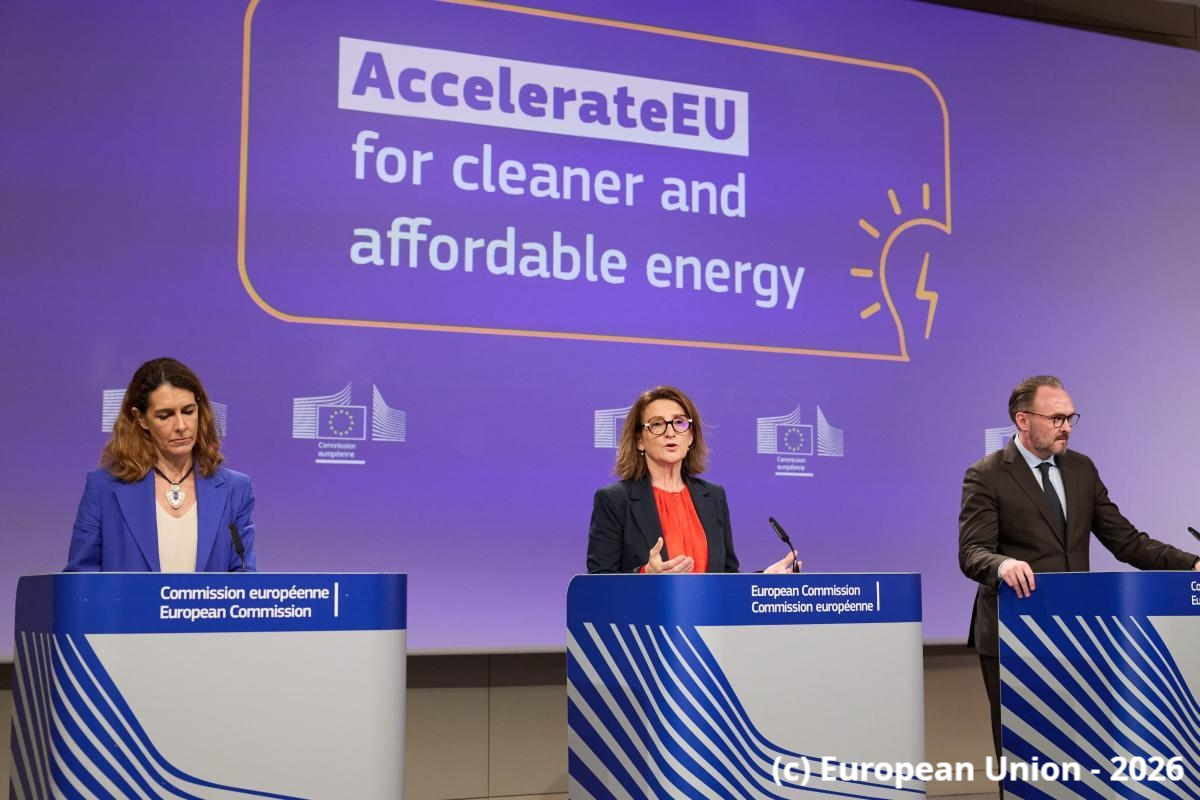
EU Commission launches AccelerateEU, combining emergency measures with clean tech support as energy price pressures persist
Share this page
by Rosita Zilli, Policy Director, and Marianne Lazarovici, Policy Officer
As the war in the Middle East continues to escalate, bringing energy prices at record high levels, on 22 April, the European Commission presented its plan in response to the unfolding energy crisis, titled AccelerateEU. The package includes short-term relief measures and deeper structural reformsto address rising energy costs. The main propositions concern coordination, consumer protection, electrification, boosting investment, and strengthening infrastructure.
According to the European Commission, since the escalation of the conflict in the Middle East, the EU has spent an additional €24 billion on energy imports due to higher prices. In its oil markets report for April, the International Energy Agency finds that global demand is expected to contract further, as scarcity and high price persist, while Eurostat finds that the price of fuels for transport has increased significantly in March (12,9% compared to March 2025). Despite its massive repercussions on the world economy, the war is showing no sign of slowing down, with talks between Iran and the United States currently on hold, over the US naval blockade of Iran, which refuses to reopen the Strait of Hormuz, through which 20% of the world’s oil supply passes.
Against this backdrop, the European Commission’s package of measures intends to alleviate the worst effects of the crisis – bringing prices down and reducing the EU’s dependence on third countries. Building on the success of the EU Energy Platform in aggregating demand and facilitating joint gas purchases, the Commission advocates for better coordination at the EU level, and intends to increase the coordination of national action on gas storage filling. Besides, it may allow for more flexibility on refilling targets if needed – up to 10% and a possible further 5% increase in flexibility in the future. In addition, the Commission will create a Fuel Observatory, mapping the supply of transport fuels and their availability, to help coordinating alternative supply and optimise distribution.
Next month, the European Commission will present guidance to Member States at the Energy Council meeting, proposing energy efficiency measures, as well as measures to substitute fossil fuels with homegrown clean energy. To further protect consumers and industries, the EU’s executive will also adopt a State aid temporary framework allowing Member States to develop and implement targeted temporary emergency measures. Moreover, the Commission will also support Member States in establishing financial incentives to support the adoption of clean technologies such as electric vehicles and heat pumps.
In parallel, medium-term actions will continue to be rolled out to accelerate the shift to decarbonised and domestic supplies of energy. The AccelerateEU initiative notably promotes electrification – with a specific target to be set – the deployment of nuclear, solar thermal, and geothermal energy, biomethane, sustainable biofuels and renewable hydrogen. Amongst measures, the Commission will continue to phase-out fossil fuels subsidies, derisk geothermal schemes and promote international cooperation, as well as support the development of large-scale solar thermal projects and present a targeted review of the production criteria for renewable hydrogen. Several actions will also be taken to support the EU’s energy system, including accelerating negotiations on the EU Grids package and fast-tracking the implementation of the Energy Highways initiative, which will address eight bottlenecks across European energy infrastructure. Lastly, the AccelerateEU package will work towards mobilising public funds and scaling up private investment in the energy transition, while modernising the EU Emissions Trading System and further facilitating the use of its revenue to accelerate electrification.
These ambitions also appeared at the heart of the Foreign Affairs Council of 21 April, where Ministers approved conclusions on EU energy and climate diplomacy calling to strengthen sovereignty and advance the global clean transition by supporting European clean tech, promoting resilience and cooperation. EERA welcomes the EU’s renewed attention to key matters such as energy efficiency and electrification – two important enablers of the energy transition, and will continue to highlight the central role of research and innovation in their uptake.
Login as an EERA member
In case you are an EERA member and don’t have login details, please contact secretariat@eera-set.eu
Join EERA
You are not an EERA member yet? Then you are missing out on a lot!
EERA gathers the best energy researchers and infrastructures in the whole of Europe
EERA makes your voice heard in the political discussions at the European level
EERA offers great networking opportunities with peers from your discipline - and others