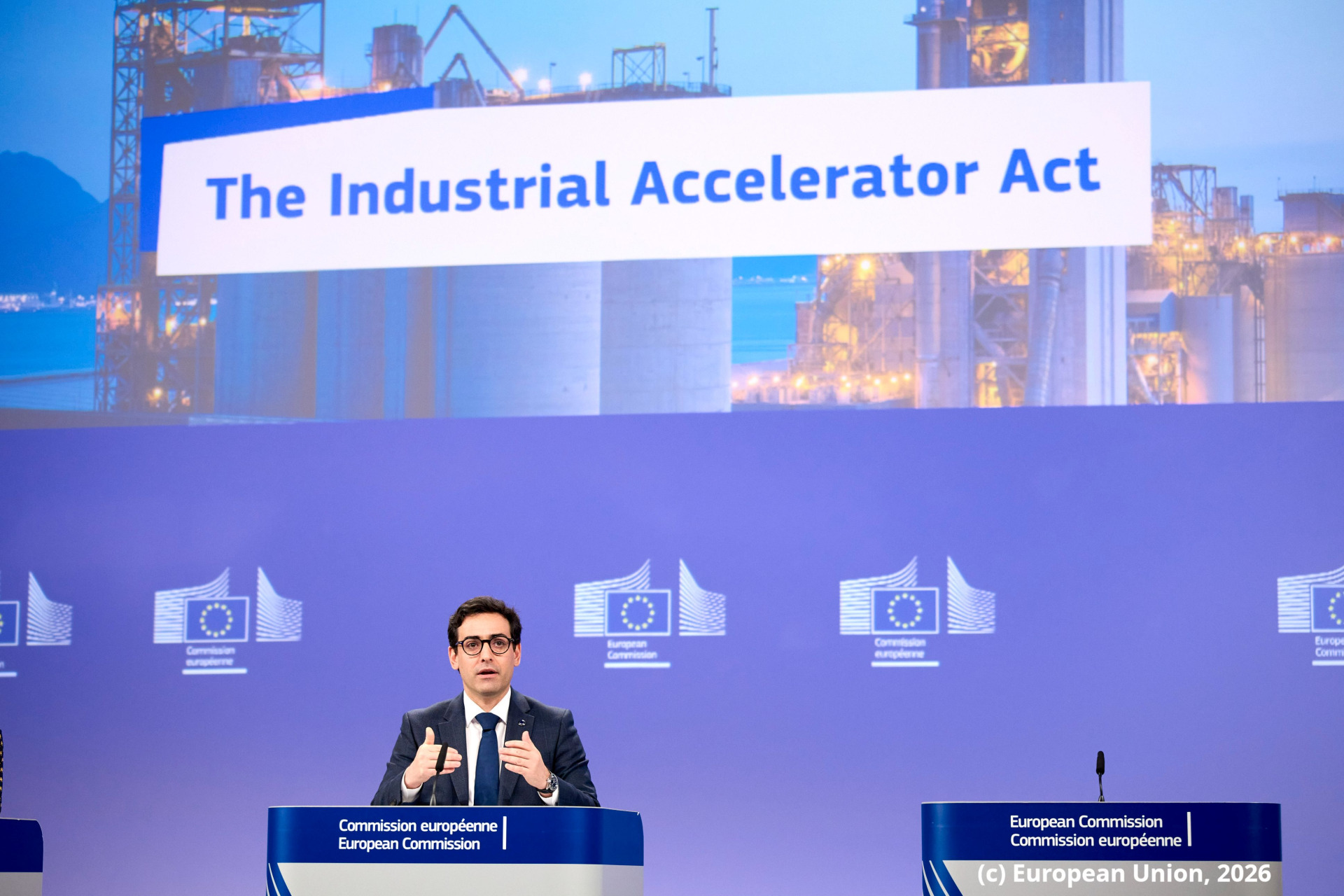
EU Commission unveils Industrial Accelerator Act to boost low-carbon production, “Made in Europe” hits regulatory spotlight
Share this page
by Rosita Zilli, Policy Director, and Marianne Lazarovici, Policy Officer
On 4 March, the European Commission presented its long awaited Industrial Accelerator Act (IAA). The proposal aims to boost demand for low-carbon European-made technologies and products while addressing their high costs and foreign competition. The file has been at the centre of political debate in recent months, with its publication delayed several times since December 2025. Originally called the Industrial Decarbonisation Accelerator Act, the IAA’s name was shortened—dropping the decarbonisation reference, sometimes described as “greenhushing”—but its content remains central to the EU’s energy transition and decarbonisation strategy.
The Act sets a target to raise domestic manufacturing’s share of EU GDP to 20% by 2035, up from 14.3% in 2024, and introduces “Made in EU” and low-carbon requirements for public procurement and support schemes. These criteria apply to strategic sectors, including steel, cement, aluminium, cars, and net-zero technologies, with the aim of increasing demand, boosting EU production capacities, and reducing strategic dependencies. The IAA does not yet define what constitutes “low-carbon” steel, aluminium, or cement, which will need clarification in future delegated acts.
Initially, the IAA requires that 25% of steel products bought through public procurement for construction or transport meet “low-carbon” standards, while 25% of aluminium and 5% of cement purchases must meet both “low-carbon” and “Made in EU” criteria. For batteries, heat pumps, solar PV, hydrogen, onshore and offshore wind, and nuclear technologies, the Act introduces progressive localisation requirements. For example, one year after entry into force, at least one component of wind turbines must be made in the EU, increasing to two components after three years, while heat pumps must be entirely produced in the EU after three years.
The Act also specifies which non-EU partners benefit from equal treatment in public procurement: those with a free trade agreement, customs union, or party to the Agreement on Government Procurement. This could include up to 40 partners, such as the United Kingdom, Morocco, Turkey, Canada, and Japan.
New rules on Foreign Direct Investment (FDI) apply to strategic sectors worth over €100 million where a single third country controls more than 40% of manufacturing capacities. Such investments must create high-quality jobs (with at least 50% of employment in Europe), drive innovation, and transfer technology and knowledge to the EU.
The IAA received mixed reactions on publication. The automotive sector warned of supply chain disruption and rising prices, while EU suppliers highlighted its potential to safeguard jobs and domestic factories. NGOs called for measures beyond public procurement, and the hydrogen industry sought stronger lead markets and higher steel procurement quotas. Regulatory complexity due to forthcoming delegated acts also raised concerns. In EERA’s view, the IAA represents a significant step forward in strengthening European clean energy and industrial potential, with low-carbon energy R&I well placed to contribute, though careful monitoring will be essential as the proposal moves through discussion and adoption.
The Act will now be discussed by EU Member States and the European Parliament, where Renew MEP Christophe Grudler, sitting on the Committee on Industry, Research and Energy (ITRE), has been appointed rapporteur.
Login as an EERA member
In case you are an EERA member and don’t have login details, please contact secretariat@eera-set.eu
Join EERA
You are not an EERA member yet? Then you are missing out on a lot!
EERA gathers the best energy researchers and infrastructures in the whole of Europe
EERA makes your voice heard in the political discussions at the European level
EERA offers great networking opportunities with peers from your discipline - and others